Corporate Governance at Jasa Raharja
Risk
Management
A. Introduction
Risk management is an integral requirement for strengthening the principles of Good Corporate Governance (GCG). In an ever-changing business environment fraught with uncertainty, the implementation of effective risk management is crucial to ensuring sound business practices that deliver added value in line with stakeholder expectations. Every element within an organization—from top management to all employees—plays a vital role in creating a trustworthy and sustainable business environment. With a shared commitment to managing risk, a company can increase its chances of achieving the goals and targets outlined in the Company’s Budget Work Plan (RKAP).
PT Jasa Raharja has implemented several initiatives to raise risk awareness among all employees. The implementation of risk management at Jasa Raharja is based on ISO 31000:2018, with responsibility for risk management falling under the Directorate of Compliance and Risk Management within the Risk Management Unit. Since 2012, the risk management system has utilized a supporting application known as the Risk Management Information System (SIMR). In 2023, this application was upgraded with the addition of several supporting features designed to streamline the company’s risk management processing and reporting processes.
Risk management is one of the key elements in the implementation of corporate governance principles and also serves a strategic function in identifying various risks that the Company may face or is currently facing. The Company’s risk management also aims to protect management from making decisions that could harm the Company in the future. The Company is committed to consistently supporting the implementation of risk management as a means of fulfilling its obligation to meet Shareholders’ expectations. In its implementation, the issuance of PER-2/2023 serves to strengthen the Company’s risk management practices, which have already adopted ISO 31000:2018 Risk Management. Regarding risk maturity levels, performance metrics are calculated to reflect the overall dimensions of risk management. The implementation of risk management is expected to reinforce existing value and provide added value to the Company.
B. Fundamentals of Risk Management Implementation
The legal compliance considerations underlying the implementation of risk management at PT Jasa Raharja are as follows:
- Regulation of the Minister of State for State-Owned Enterprises No. PER-2/MBU/03/2023 on Guidelines for Corporate Governance and Significant Corporate Activities of State-Owned Enterprises;
- Financial Services Authority Regulation No. 28/POJK.05/2020 concerning the Assessment of the Financial Health of Non-Bank Financial Institutions;
- Financial Services Authority Regulation No. 44/POJK.05/2020 concerning the Implementation of Risk Management for Non-Bank Financial Institutions;
- Financial Services Authority Regulation No. 4/POJK.05/2021 on the Implementation of Risk Management in the Use of Information Technology by Non-Bank Financial Institutions; and
- Technical Guidelines No. SK-6/DKU.MBU/10/2023 on Technical Guidelines for the Risk Management and Aggregation Process in the Risk Taxonomy of State-Owned Enterprises’ Portfolios.
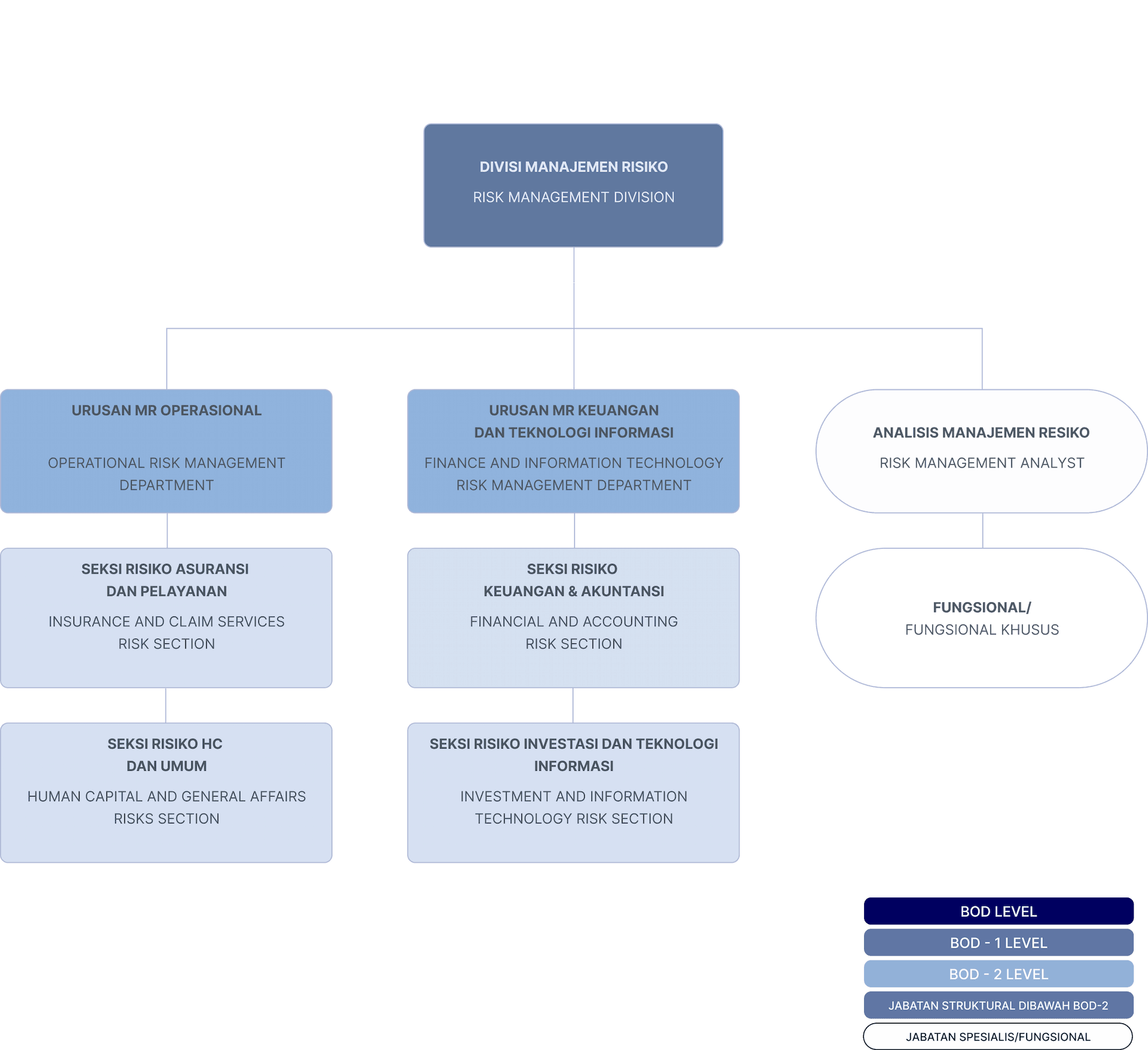
C. Organizational Structure of the MR Division